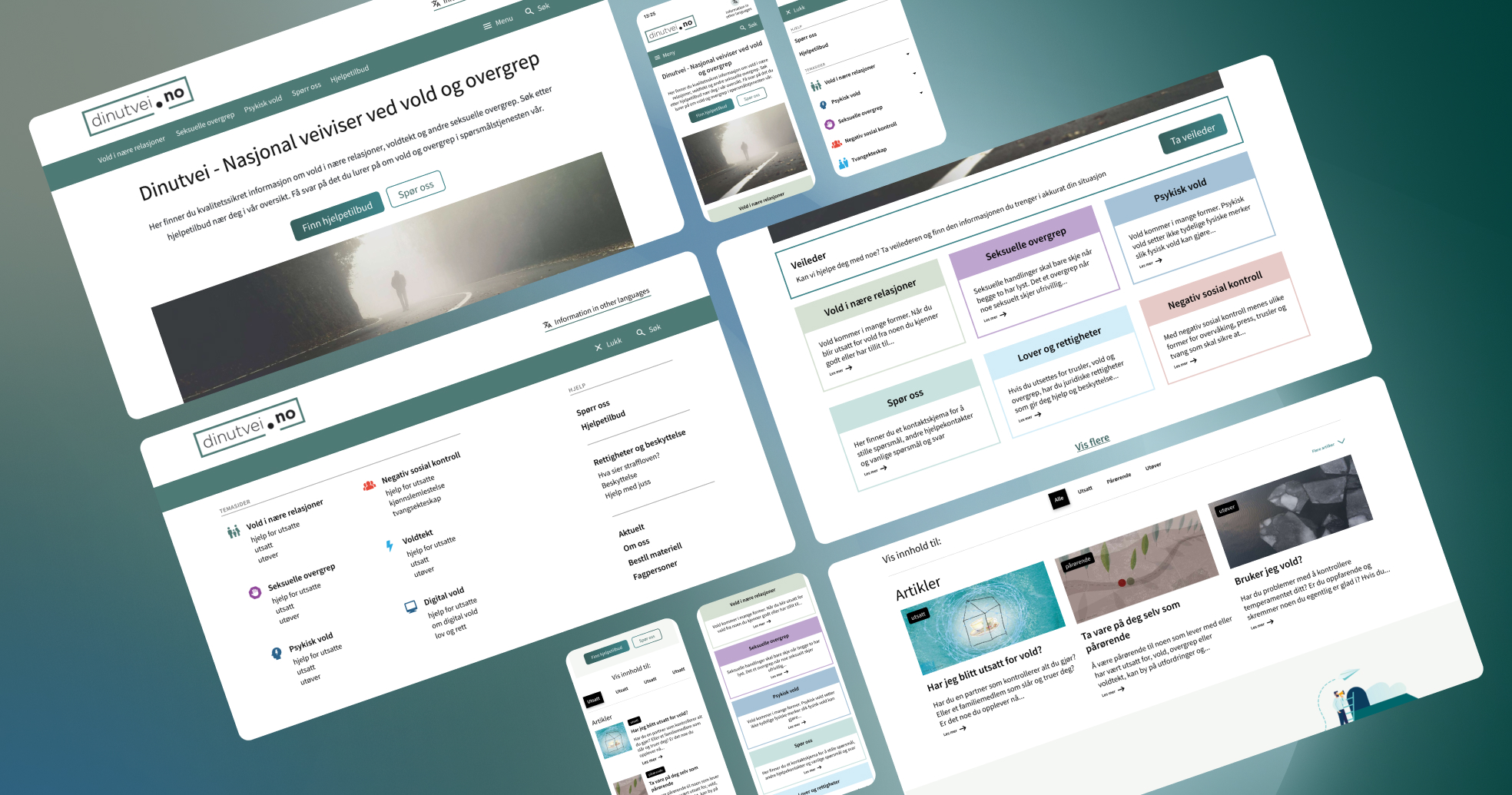
Information Architecture Redesign for a Social Support Platform

client

NKVTS

year

2023

Challenge

Dinutvei.no is a support platform providing information and resources for people affected by violence. The platform serves three different user groups:

  • people experiencing violence
  • people using violence
  • people seeking help for someone else

Due to the large number of articles covering different types of violence, the website had become complex and difficult to navigate.

Google Analytics data showed that:

  • users spent very little time on the site
  • most visitors did not continue beyond the initial pages
  • very few users reached deeper article content
  • over 80% of traffic came from mobile devices

The platform required a clearer information structure that would help users quickly find relevant help while minimizing cognitive load. This was particularly important because many visitors might be in stressful or vulnerable situations when accessing the site.

my role

I worked as the sole UX designer on the project within a team that included an art director and developers.

My responsibilities covered the entire UX process:

  • conducting a usability audit of the existing website
  • analyzing Google Analytics data to understand user behavior
  • planning and conducting moderated usability testing with 15 participants from different age groups and digital skill levels
  • analyzing test recordings and identifying usability problems
  • creating user personas based on demographic data and stakeholder workshops
  • developing a customer journey map identifying key pain points
  • redesigning the site’s information architecture and navigation structure
  • designing a clearer menu system with improved content grouping
  • designing a simple style guide and component library in Figma

collaborating with developers during implementation and reviewing the final UI

Strategic Insights

Usability testing and analytics revealed several structural problems in the original website:

  • the information architecture was chaotic and cognitively overwhelming
  • content categories were poorly grouped and difficult to scan
  • users often searched for information in the wrong sections
  • the mobile navigation hid important categories, despite the majority of traffic coming from mobile devices
  • the search function was difficult to notice

Testing also showed that users needed clear guidance depending on their situation. Many participants struggled to identify which content applied to them.

These insights led to a redesigned navigation system built around three clearly defined entry paths:

  • I am experiencing violence
  • I am using violence
  • I want to help someone

To reduce cognitive load, the information architecture was simplified and limited to a maximum of three levels of depth.

Content grouping was improved and key help resources were surfaced higher in the navigation. A mega menu with clear categorization and icons was introduced to make scanning easier.

The icons representing types of violence were designed to be subtle and non-triggering, helping users navigate the content without causing emotional distress.

The search functionality was also made more visible to support users who prefer direct search instead of browsing.

Results

The redesigned website introduced a clearer and more supportive user experience.

Navigation & Information Architecture

  • reorganized content structure with improved grouping of articles
  • frequently searched topics and direct-help resources surfaced higher in the menu
  • introduction of a mega menu with clear categorization and icons for faster scanning
  • dedicated mobile navigation designed specifically for mobile users

Content Discoverability

  • improved article descriptions helping users decide what to open
  • stronger visual hierarchy improving readability and scanning
  • more visible search functionality

Impact

After launch:

  • users spent significantly more time on the site
  • more visitors navigated to and read article content
  • users were better able to find relevant help resources

The client reported a significant improvement in engagement and overall satisfaction with the platform.

Following the launch, the platform continued to evolve through small iterative improvements based on user behavior and feedback, ensuring the structure remained effective as new content was added.

Prev
Next